Fantasy Analysis
RB Dead Zone Long View
The RB dead zone is useful only if it stays precise. It is not “middle-round running backs are bad.” It is a price pocket where the market can overpay for backs after the elite workhorse tier is gone.
The long-view result: the 2018-2022 dead zone was real, but it was real inside a broader RB-WR scoring cycle. For 2026, the right posture is a warning light, not an automatic fade.
The Thesis
- Macro scoring comes first. Before blaming a draft range, compare RBs and WRs in the same scoring environment.
- The old dead-zone penalty was real. In 2018-2022, dead-zone RBs still lagged WRs after controlling for the broader RB-WR scoring gap.
- 2026 is a caution flag, not a verdict. Current-local 2026 ADP shows RB prices rising, but not enough by itself to prove the dead zone has returned.
- The action is price discipline. In rounds 3-6, demand either a discount or a clear role/projection edge before buying the RB.
Macro Scoring Changes The Baseline
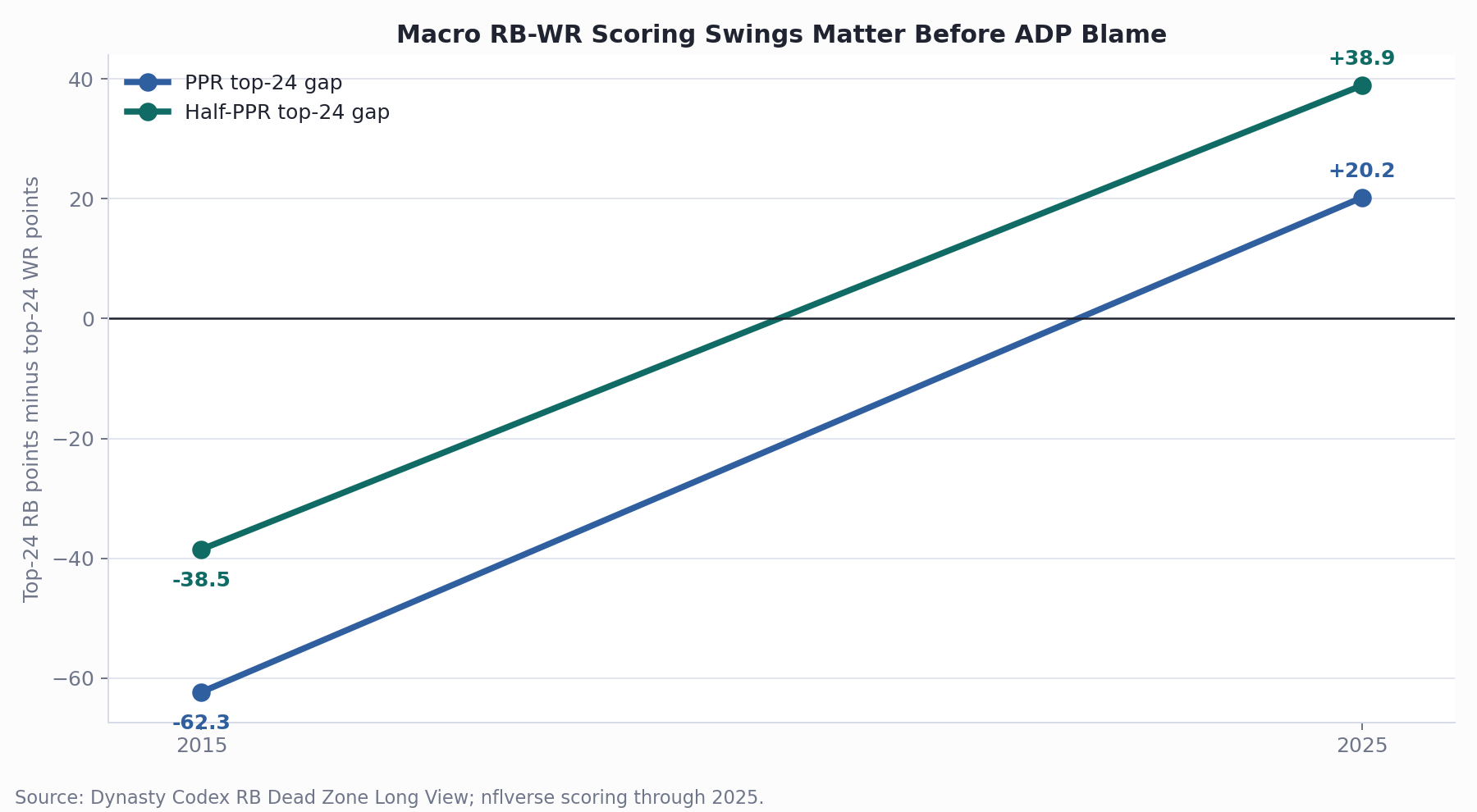
The key mistake is treating the dead zone like a static law. RB and WR scoring environments move in cycles. When the top-24 RB group is broadly trailing the top-24 WR group, a middle-round RB miss looks worse. When RB scoring rebounds, the same ADP pocket can look less toxic.
| Format | Low point | Recent rebound | Practical read |
|---|---|---|---|
| PPR top-24 RB minus WR | -62.3 in 2015 | +20.2 in 2025 | A WR-friendly macro environment can make RB ADP pockets look worse than price alone. |
| Half-PPR top-24 RB minus WR | -38.5 in 2015 | +38.9 in 2025 | Recent RB scoring strength is real, but it does not prove the dead zone disappeared. |
The 2018-2022 Penalty Survived Macro Control
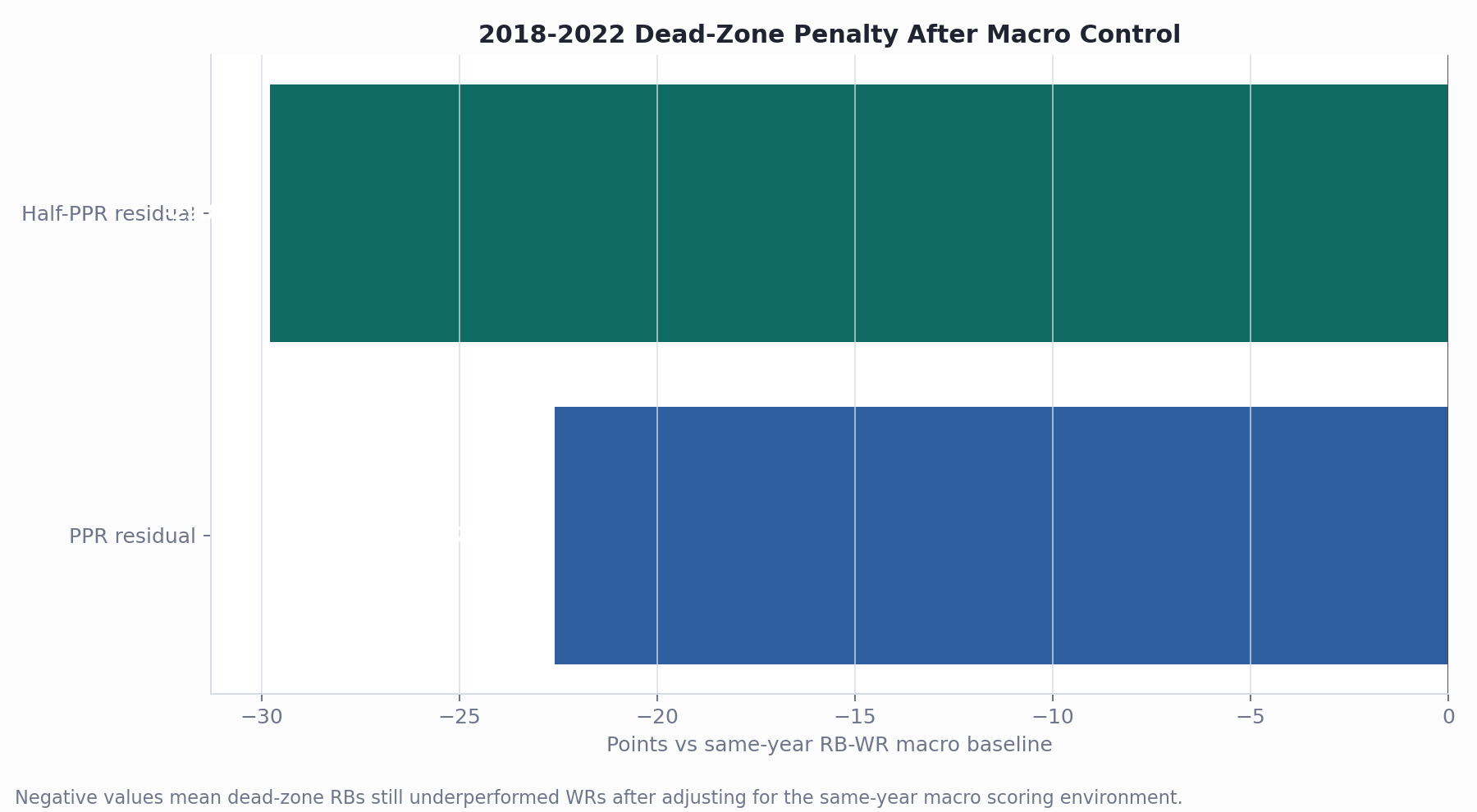
The original dead-zone window still matters. From 2018-2022, PPR dead-zone RBs averaged 41.4 fewer points than comparable WRs. After adjusting for the same-year macro RB-WR scoring environment, the residual penalty was still negative.
| Format | Raw dead-zone gap | Residual vs macro baseline | Action threshold |
|---|---|---|---|
| PPR | -41.4 points | -22.6 points | Demand a discount or a clear role/projection edge when RB prices resemble the 2018-2022 high-price regime. |
| Half-PPR | Not the primary raw-gap line | -29.8 points | Use the same caution, with the caveat that the local half-PPR ADP pull covers 2018-2024. |
This is the useful part of the dead-zone idea: not that every middle-round RB is doomed, but that the market can pay RB prices that still lose to same-range WRs even after adjusting for the scoring environment.
2026 Is A Warning Light
Current-local 2026 Sleeper ADP has 15 PPR RBs and 17 half-PPR RBs inside the top 36. That is higher than the recent trough, but still below the old 2018-2022 danger level around 19 RBs.
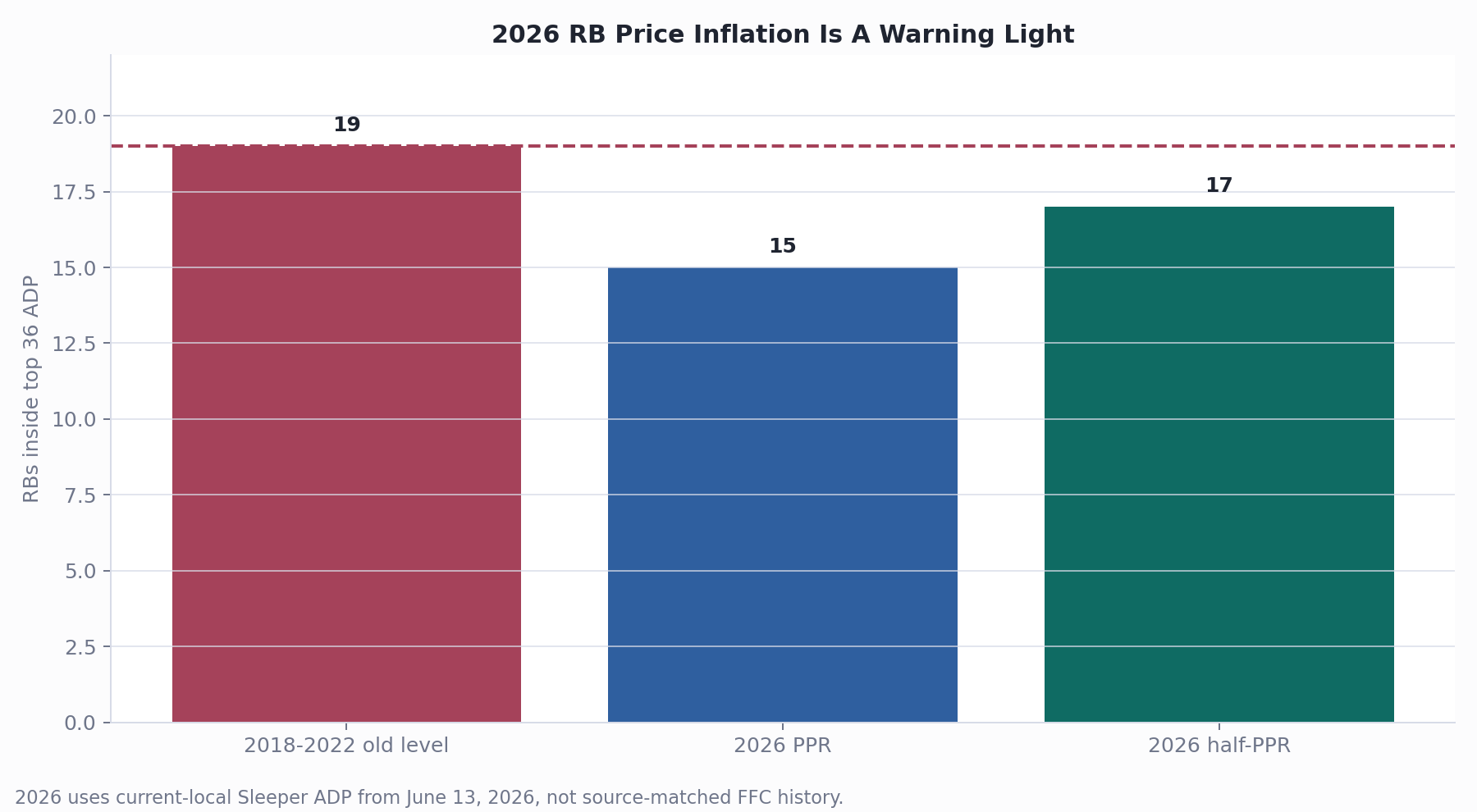
The read is deliberately restrained: price pressure matters, but price alone is not the whole dead-zone claim. The dead zone becomes more actionable if top-36 RB counts climb toward 19-plus or if the 2026 scoring environment turns WR-favorable.
Historical Half-PPR Price Context
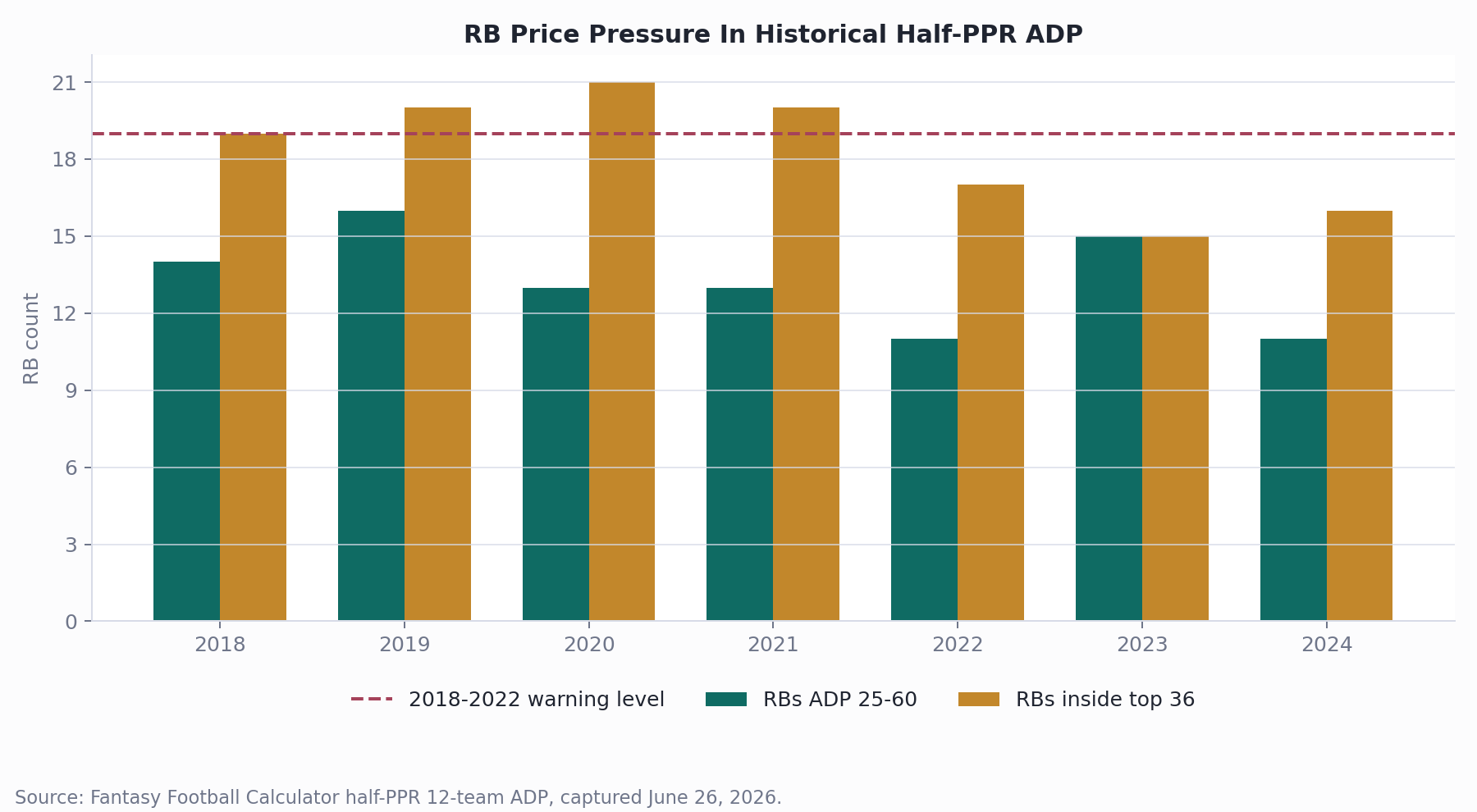
The half-PPR ADP capture gives a clean view of the 2018-2024 price band. RBs drafted between picks 25 and 60 stayed structurally present every year, while the top-36 RB count cooled after the 2018-2021 high-price stretch.
| Season | RBs ADP 25-60 | RBs inside top 36 |
|---|---|---|
| 2018 | 14 | 19 |
| 2019 | 16 | 20 |
| 2020 | 13 | 21 |
| 2021 | 13 | 20 |
| 2022 | 11 | 17 |
| 2023 | 15 | 15 |
| 2024 | 11 | 16 |
Current Application
The 2026 takeaway is not “avoid all RBs in rounds 3-6.” It is:
- Compare the current RB price pocket to the same-year scoring environment.
- Escalate caution if the top-36 RB count moves toward 19-plus.
- In rounds 3-6, prefer backs with role certainty, projection support, or a visible discount.
- Be willing to take WRs in the same range when the RB case is only “he is the next back up.”
Draft-room posture: treat the dead zone as a warning system. It should make you ask for evidence, not automatically cross off the position.
What Not To Carry Forward
| Signal | Why it is noise |
|---|---|
| The RB dead zone has disappeared permanently. | The long-run scoring environment is cyclical, and the recent RB rebound is only a short window. |
| 2026 RB prices guarantee the dead zone is back. | Current-local 2026 prices are not a clean return to the 2018-2022 regime, and 2026 scoring is unknown. |
| Sleeper 2026 ADP is a direct continuation of Fantasy Football Calculator history. | It is useful price context, but it is not source-matched to the historical FFC series. |
Before Acting
- Refresh 2026 ADP before using this as current draft advice.
- Recheck the RB-WR macro scoring environment during and after the 2026 season.
- Backfill or source-match half-PPR ADP gaps before leaning heavily on a half-PPR trend line.
- Treat player-level exceptions as role and price cases, not proof that the zone is gone.
Sources and freshness: Historical scoring uses Dynasty Codex nflverse data through 2025. Historical PPR ADP is carried from the RB Dead Zone Long View report; half-PPR ADP uses a Fantasy Football Calculator 12-team capture from June 26, 2026 covering usable local rows for 2018-2024. Current 2026 price context uses a current-local Sleeper ADP snapshot from June 13, 2026 and has not been live-refreshed.